Share this article
Blog2026-05-18
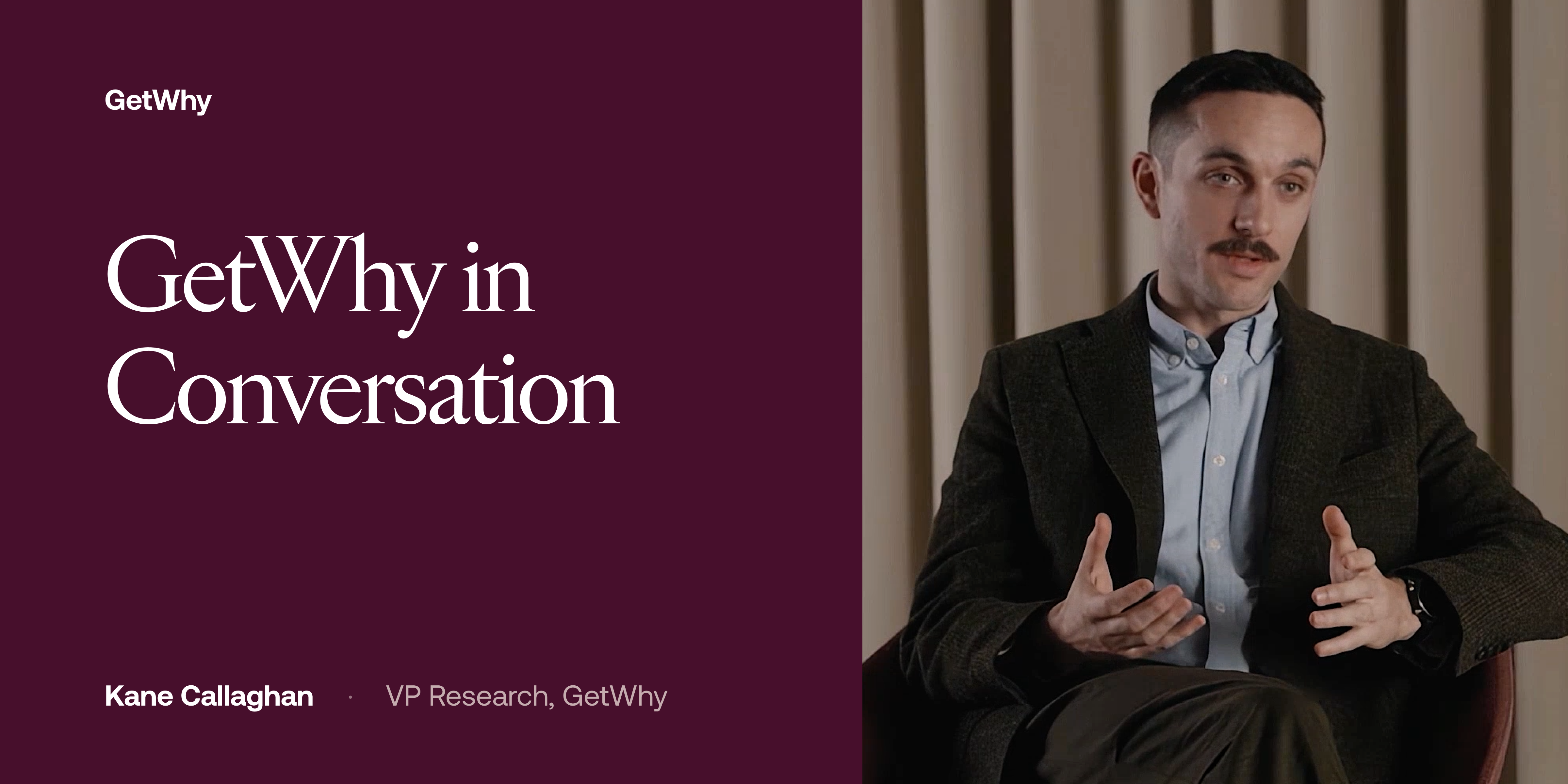
GetWhy in Conversation: Kane Callaghan, VP Research
Written by:
GetWhy
Part 1 of an ongoing series getting to know the people behind GetWhy.
Kane Callaghan has spent his career asking one question in many different contexts: how do you turn messy human data into decisions that actually hold up? From academic research to government policy to consumer insights, his answer has always come back to methodology. As GetWhy's VP Research, he's now applying that same thinking to one of the industry's biggest challenges and making sure AI-powered research is not just fast, but genuinely good.
Your career spans academia, government, and now consumer insights. What's the through line?
It all comes back to methodology. My PhD was in political communication, specifically, how policymakers find and evaluate information when making decisions, and whether that understanding could be located in social media data and public commentary. From there I moved into the Australian government, deploying that methodology to capture citizen commentary on policy. Then I joined the qualitative team at Kantar, moved to Copenhagen with my Danish partner, and eventually landed at Sonar, where I led the client research team as director for a couple of years.
Now at GetWhy I'm embedded in the product team, finding new ways to combine that methodological rigor with the latest tech.
What does GetWhy need from someone with your background?
My job is to make sure that the products and systems we're building have genuine methodological rigor and qualitative expertise embedded in them. When we develop AI-moderated interviews, for example, how do we ensure the AI follows best practices for interview moderation? When we build a new model to analyze interview data, how do we make sure it's rigorous, deep, and methodologically sound?
Why is it important to build these new systems?
If we're ever going to truly scale—and I mean both scale GetWhy as a company and insights as business function—we need to produce more research than we have researchers. And it needs to be incredibly high quality.
You can build systems that are quick and generate a lot of data, but unless you do it at high quality, you're just producing a lot of shit really quickly. That analytical rigor has to be embedded into what we build from the start.
What does it take to translate research expertise into something a system can replicate?
Part of it is recognizing that the different stages of a research project require fundamentally different skills. Writing a good brief, that is, turning a business challenge into a piece of work, requires curiosity, methodological knowledge, knowing when to push back on a client's question or challenge their hypothesis.
Moderation is something else entirely: building familiarity, recognizing patterns, spotting contradictions. These are definable stages in the research journey, with definable skill sets. If you can define and measure those attributes, you can build systems that reach them.
There's a lot of talk in the industry about AI replacing research. What's your take?
I think the more interesting question is what changes when speed, scale, and frequency fundamentally shift. The industry, the technology, it’s all moving so fast. Our six-month horizons become six weeks. And that calls into question entire operating models. What does it mean to run a campaign evaluation program, or build personas, or map out buying journeys, when the research can happen at that speed and scale?
What becomes possible that wasn't before, and what does that actually look like in practice?
The most valuable thing we can offer a large enterprise client is compounding account knowledge. Every subsequent piece of research makes the system stronger. You can search across years of interviews, thousands of data points, to find patterns over time.
Most importantly, you can identify blind spots. Where don't you have data? What are your known unknowns? That level of visibility into a knowledge base simply hasn't been possible in qualitative research before.
Final thoughts?
There’s a lot of talk about human vs. AI moderators, and which is better or more reliable. To me, it isn’t about which is ‘better’ (however one might define that), it’s about identifying the right application areas, and recognizing when and how AI moderation can provide a meaningfully different experience.
But there's one more thing that no human can do: an AI moderator can draw from that entire dataset in the act of moderation itself. We haven't fully come to terms with the power of that yet.

