Share this article
Blog2026-07-14
How we taught the platform to spot fake participants
Written by:

Adam Mezővári
Senior AI Engineer
A good recruiter can feel when a participant is off. The room in the video doesn't match the country. The accent doesn't fit the market. Something in the background gives it away. For years, that expert judgment lived in people's heads and got applied one interview at a time.
So we set out to teach our platform to do the same, working alongside the people who do it best.
We sat down with our recruitment team, the people who catch fakes for a living, and asked them how they know. Then we took what used to live in their heads, applied one interview at a time, and built it into a system that runs on every single one.
The 20% you never see
On average, across our qualitative research studies, GetWhy rejects about one in five participant interviews (though that number greatly varies depending on studies and markets). Some are outright fraud. Others simply don't fit the study, or their answers aren't deep enough to use.
We take them out and recruit new participants to replace them, so what reaches your analysis is only the real, qualified people. Because a fifth of your sample being fake or low quality is enough to change what a study concludes, and the decisions you make from it. That is why we obsess over catching them.
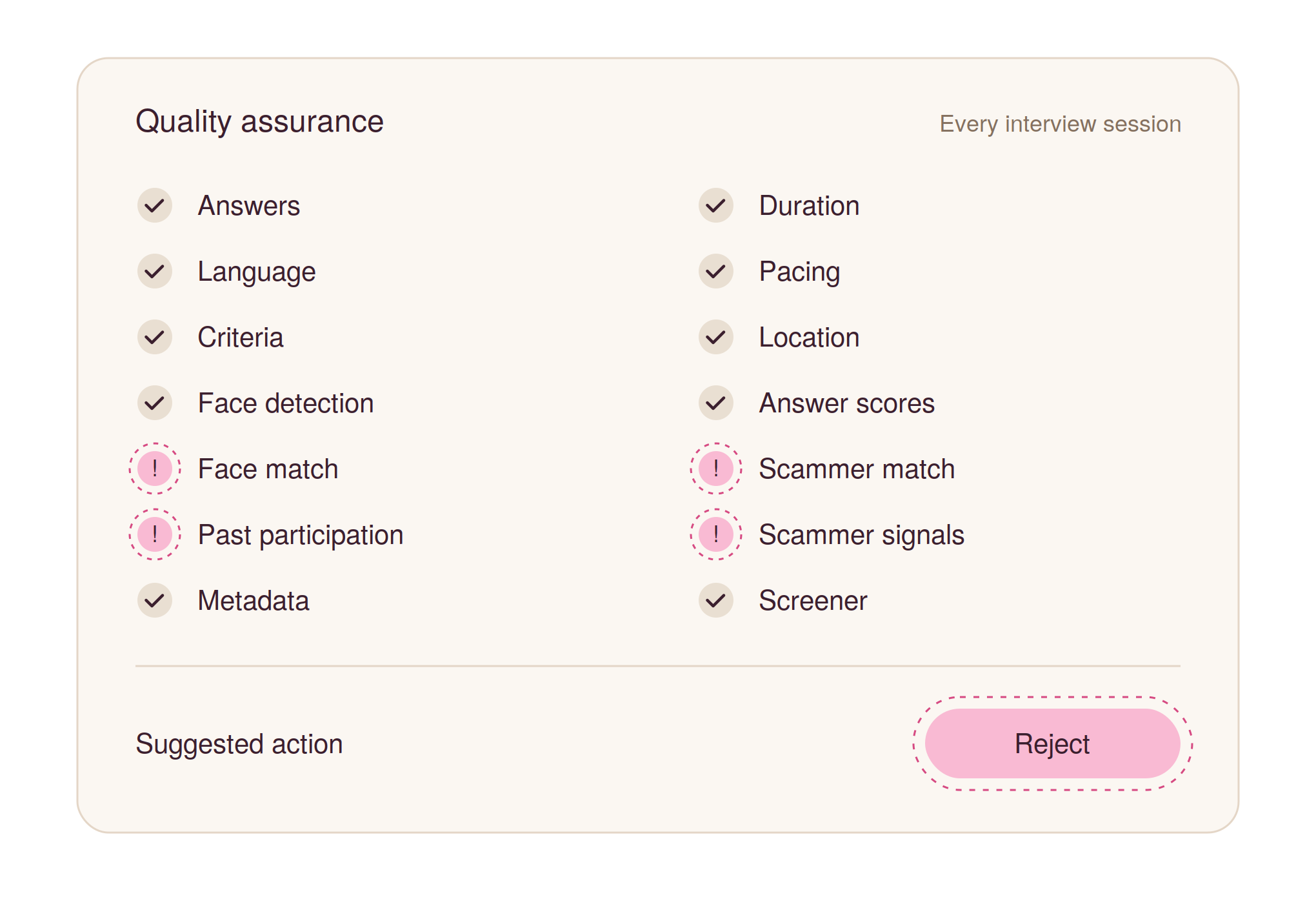
So we built a layered defense we call Scammer Signals. Five independent checks, each reading the interview from a different angle.
The Scammer Signals we check in every interview
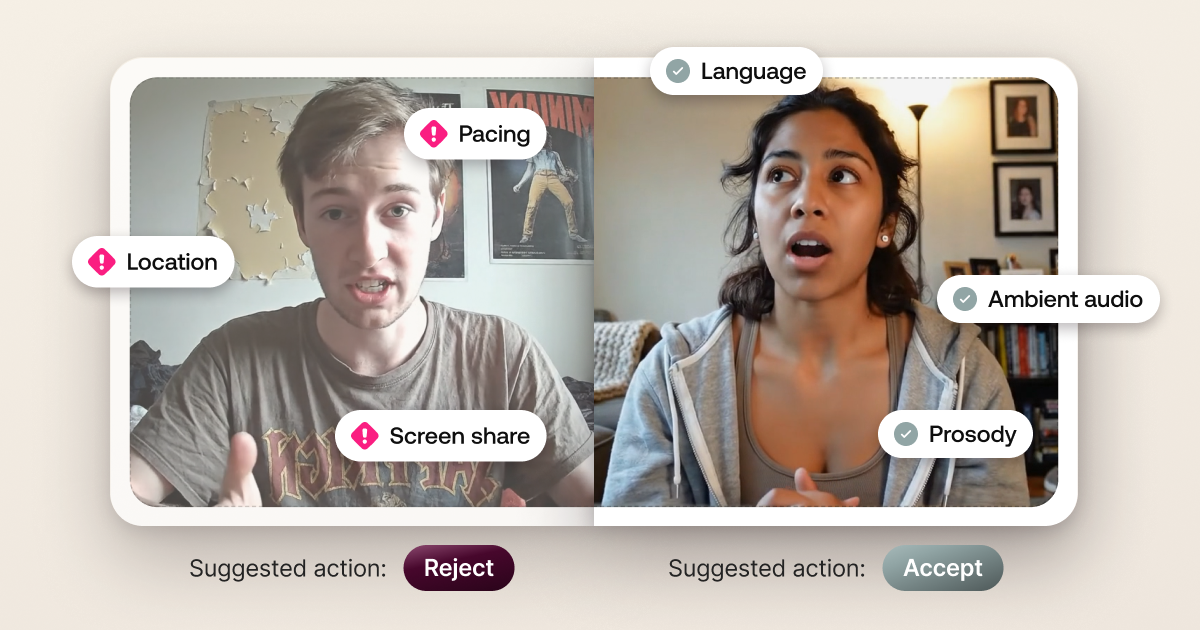
These are the checks written into every GetWhy interview. Each one looks at a single thing:
- Environment - Does the room match the country the participant claims? We read the scene: outlets, architecture, seasonal and climate cues, signage.
- Ambient audio - What does the background sound like, and does it fit the market?
- Accent - Is this a native speaker of the study's target dialect?
- Prosody - Is this natural, spontaneous speech, or someone reading off a script?
- Screen share - Do the on-screen details line up with where the person says they are? Think the clock and timezone, the keyboard language, the weather widget.
We built these five to work in isolation. The accent check doesn't know what the environment check saw, and neither knows what the screen check found. That was on purpose.
When independent checks reach the same conclusion, the agreement means something real. It isn't the model talking itself into an answer it already expected.
Each angle produces its own score, and we combine them into a single read on the interview. We also built in some humility. When we only have a short clip to work with, the audio checks quietly lower their own confidence, so a thin signal can never push a real participant over the edge.
The scammers we've seen before
The five signals are built for someone we've never seen. But a lot of fraud isn't new.
The most persistent scammers are repeat offenders who work at scale, applying to study after study across different clients. Each time, they change the things you'd normally recognize them by: a new name, a new email, a new panel account.
The one thing they can't change is their face. Scammer Match is built on that.
When our team confirms a scammer, that person goes on record, and from then on, the platform checks every new interview against that record, across every client we work with. And there's no time limit. Someone confirmed two years ago is still caught today.
But a visual match isn't the final word: it goes to a second check that decides whether it's genuinely the same person, so a passing resemblance never costs a real participant their place. It's the same principle as the signals. The system raises its hand, and a person makes the call.
What keeps this fair, rather than a blacklist, is how someone gets on the record in the first place. Nobody is added on suspicion. A human confirms every entry, and the check works from the face alone, not from the names and emails scammers cycle through.
The payoff is a defense that gets stronger the more we run. Every scammer caught on one study is one that every other client is now protected from. A catch anywhere is a catch everywhere.
Scammers get smarter. So do we.
Sometimes the tell is tiny. In one interview, a member of our recruitment team spotted a faint reflection in the participant's glasses. Instead of answering honestly, they were reading their answers off a chatbot on a second screen. QA flagged it and rejected it.
It’s that kind of catch that is continuously teaching the system. That's why we build the checks around broad inconsistencies rather than any single trick, and we keep retuning them as the team catches new ones. Scammers keep getting smarter. So does the system we built to catch them.
What does this means for your results?
Cleaner inputs. The interviews that reach your analysis are far more likely to come from real, qualified people who are who they say they are. Every insight you draw, every decision that follows, rests on who was actually in that interview.
That is the whole point of this work. Better decisions start with data you can trust, and you shouldn't have to take that trust on faith.
What this means for AI-moderated research
AI-moderated interviews only work if the person on the other side is real, qualified, and answering honestly. Scale only makes that harder. The more interviews you run, the more chances a weak one has to slip through. Fraud detection is what lets AI-moderated qualitative research scale without lowering the bar.
It also sits inside a bigger system. Recruitment decides who gets into a study in the first place. AI moderation keeps the conversation deep and on track while it happens, measured against our 17-criteria evaluation framework. Checks like these catch what slips through afterward. Clean recruitment means fewer fakes to catch.
Rigorous moderation means richer answers to work with. And catching fraud at the end means the insights you act on came from the people you actually wanted to hear from.
FAQ
Does the AI decide who gets rejected?
No. Today, the checks advise. They surface risk and explain why they flagged an interview, and our recruitment team makes the call. We are increasing how much the checks can decide on their own, but only as we validate each one against real interviews.
Is this a privacy concern? What are you actually looking at?
We look at cues, not people. The environment check reads the room, not the participant's appearance. The screen check reads the clock and the taskbar language, not what the person is doing on screen. The AI models run on managed cloud infrastructure, and your data is never used to train shared models. GetWhy is GDPR compliant.
What if a study can't use video?
Some of these checks rely on video, so they work best on video interviews. Some markets run cameras-off by convention, and some hard-to-reach audiences may too. In those cases, we lean on the checks that still apply, like background audio and accent, and we don't penalize a participant for a check we simply couldn't run.

