Share this article
Blog2026-08-10
What We Heard at Quirk's New York, and What Our Own Data Says About It

Written by:
GetWhy
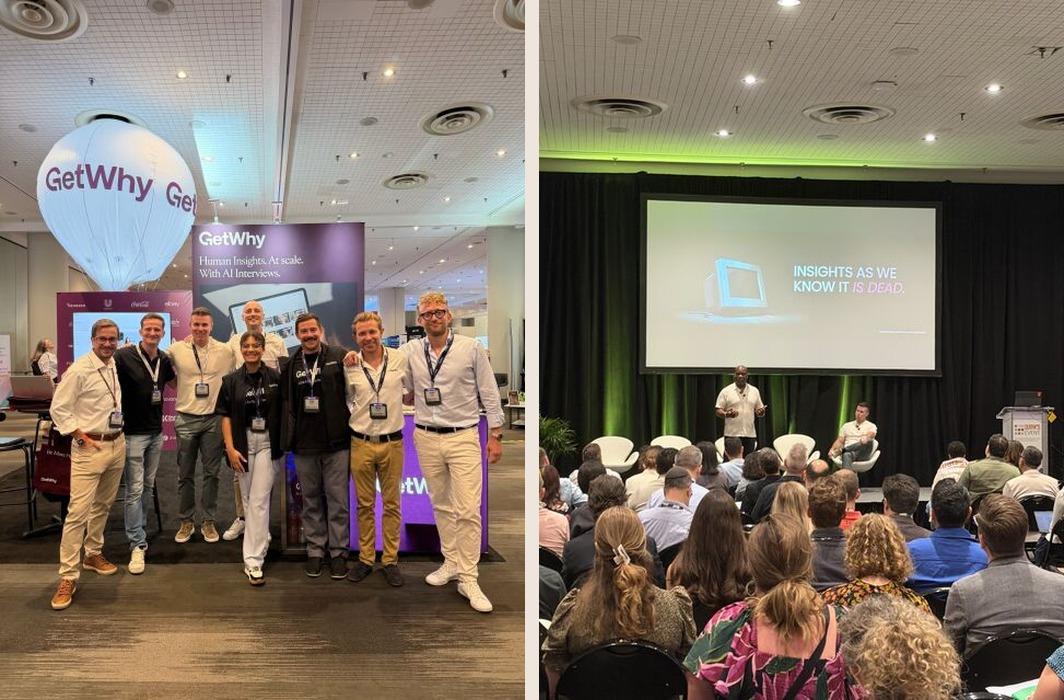
Quirk's New York was busy this year, in the best way. The show floor was packed, the sessions were full, and almost every conversation we had circled back to the same question: how is AI shifting the future of insights?
We had a front row seat to that question twice. On Wednesday, Casper Henningsen, our CEO and co-founder, joined Thomas Walker, VP of Global Consumer Insights at eBay, to talk about what happens when insights stop being a project-based function and becomes something closer to an always-on decision engine. It's a shift from insights answering questions when asked to insights anticipating what the business needs to know before it asks. As part of the session, Thomas shared how GetWhy's AI-moderated research platform is helping eBay bring customer understanding into business decisions faster and at greater scale.
On Thursday, Lasse Telling, our CCO, sat down with Tony Costella, Global Commerce AI and Performance Transformation Director at Heineken, for a different but related conversation. Their session argued that consumers were never the fixed, mappable landscape insights teams have long treated them as. They're more like weather systems: constantly moving, shaped by context and category dynamics. Tony's point was that insights needs to become an early-warning system, detecting shifts in consumer behavior before they show up in a quarterly report.
Both rooms were full, and the questions afterward ran long, which told us something on its own.
None of it felt like a coincidence. A few weeks before Quirk's, we wrapped an internal study of ten senior insights and marketing leaders in New York, all of them managers, directors, or VPs who plan and commission qualitative research for a living. What they told us lines up closely with what was on stage this week. Here are the three things that stood out.
The Project-Based Model is Breaking
Nearly every leader we spoke with pointed to the same two pain points: finding niche or hard-to-reach participants, and the slog of manual transcription and analysis once the interviews are done. It's pushing teams to over-invest in upfront planning and stakeholder alignment, and to lean on tools like Dovetail, Qualtrics, Gong, and Adobe Analytics as workarounds rather than a real fix. One participant described how much time goes into shaping the story for a presentation after the interviews are already done, before a single insight has reached a stakeholder.
That's the same gap Thomas Walker named on stage. A model built around individual studies and individual reports can't keep pace with businesses that need customer understanding available at the moment a decision is being made. The bottlenecks our study surfaced aren't something another point solution can patch over. They're evidence that the project-based model itself has hit its limit and closing that gap takes a platform built for it, not one more tool stitched into the old workflow.
Leaders Want AI in the Room, but Only with Proof
The leaders in our study are genuinely open to AI-moderated research. They cited efficiency, cost savings, and a more relaxed experience for participants as real benefits. But that openness comes with conditions. Their biggest concerns were hallucinated outputs, losing conversational nuance, missing body language, and the ethics of it all. Before anyone would present AI-generated insights to a senior stakeholder, they want human oversight, transparent outputs backed by sourced evidence, and third-party validation, whether that's a case study or an outside endorsement.
That expert-in-the-loop model is exactly what GetWhy runs on. We're full-service, with a dedicated research team behind every study, not AI running unsupervised. Human expertise shapes, calibrates, and validates every step of our AI-driven research engine, because best-in-class insight takes both technological precision and deep methodological rigor.
That's exactly what eBay's own experience shows: a real account of AI-moderated research holding up at scale, not a vendor's promise. It's also the underlying challenge in Heineken's early-warning framing. Detecting a shift in consumer sentiment earlier is only useful if the business trusts the signal enough to act on it.
Trust is Hard to Earn and Easy to Lose
Vendor relationships in this space are built almost entirely on referrals and prior working relationships. They fall apart just as fast, usually over opaque pricing, missed recruiting accuracy, slow communication, or fees nobody agreed to upfront. Whether a vendor is AI-powered or fully human, the bar is the same: show up with transparent pricing, prove recruiting quality fast, and communicate before you're asked to.
It's why real examples like eBay's matter as much as the technology itself. Leaders aren't looking to be told AI-moderated research works. They're looking for evidence that it already has, somewhere they can check.
Where This Leaves Us
The conversations at Quirk's weren't a surprise so much as a confirmation. The leaders on stage and the leaders in our study are asking for the same things: a model that keeps up with how fast decisions actually get made, AI they can trust enough to put in front of their own stakeholders, and proof before they commit. That's the brief we are building against.